Groove pockets
What the pocket is, where each voice sits, and the mistakes that kill it.
It's between the parts, not in one of them
The pocket is the rhythmic sweet spot where the kick, clap, hats, and bass lock into one shared feel.
It's the thing that makes people move.
A funk bassist put it best: the pocket is "the space that exists between the kick, snare and hi-hat." (The backbeat = the clap or snare on beats 2 and 4.)
Three things are always true.
It's collective — one player can't pocket alone. Everyone has to agree on the tempo and the feel.
It's about constancy, not perfection — the same placement, bar after bar. A drummer who drifts is rushing. A drummer who sits 8 ms behind the beat for four minutes straight is pocketing.
It's felt in the body. The test: does it make you nod?
Urgent, driving
The backbeat lands slightly early — pushed.
Feels aggressive, forward. Like pushing the center of the song ahead of you.
In dance music, pushed percussion = momentum.
Swagger, heavy
The backbeat lands slightly late — laid-back.
Relaxed, open. Same tempo, but every hit arrives at the last comfortable moment.
Laid-back doesn't mean slow. It means the groove has room to breathe.
A rigid statement
Neutral, precise — "like a drum machine." Not worse, a different aesthetic.
Techno often wants dead-on on purpose.
Note: the backbeat placement is where listeners feel it most. The hats and kick can sit somewhere different from the snare.
Think in flams
A flam = two hits almost on top of each other.
If the second hit is on the beat, the first was early — play just that first hit and you're pushing.
If the first hit is on the beat, the second is late — play just that one and you're laid-back.
Kick, snare, and hats each have their own relationship to the grid
J Dilla programmed drums that refused to be quantized — kick, snare, and hats each landing slightly off the grid in different directions.
That's the lurching "drunken" swing.
Questlove carried it into D'Angelo's Voodoo (2000), recorded about 85% live to tape with almost no editing: "loose enough to breathe, tight enough to stay locked."
The lesson: Dilla's pocket comes from different placement between the parts — hats pushing while the snare lays back. Not from one global shift.
That's exactly why a single swing knob can't copy it.
To get there, groove each voice separately (Lesson 01, per-voice grooving). Never everything at once.
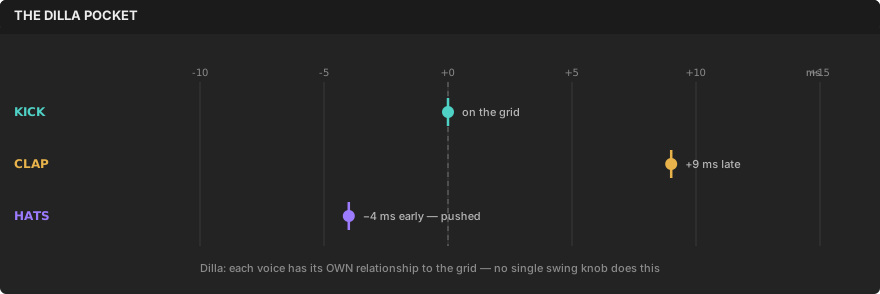
Diagram: built for this lesson
Kick pinned, pocket in the surroundings
House pockets differently from funk and hip-hop.
Why: the kick is non-negotiable. Four on the floor, dead straight, every beat.
So the pocket lives in everything around it — swung 16th hats, claps nudged slightly off the grid, percussion dancing between the kicks.
The kick is the anchor. The pocket is the conversation the other parts have around it.
The lineage in three lines. Funk: the whole band lives at the back edge of the beat — Clyde Stubblefield's ghost notes, not complexity. Hip-hop: pocket as a percentage on the MPC, the 54–62% swing zone. House: straight kick, loose surroundings. The contrast is the pocket.
| OFFSET | ZONE | WHAT TO DO |
|---|---|---|
| < 5 ms | Humanization | Felt more than heard. Removes the machine stiffness without changing the feel. This is where "humanize" functions should live. |
| 5–12 ms | The pocket zone | Placement becomes audible as laid-back or pushing. Hats 3–10 ms late for swagger, claps 0–8 ms late, bass 2–6 ms behind the kick for fullness. |
| 12–20 ms | Character zone | Approaching Dilla territory. Fine on hats and percussion; dangerous on the kick-and-snare backbone. Past ~20 ms at house tempos, a hit reads as a mistake — unless it's a deliberate flam or shuffle. |
Plain takeaway: under 5 ms is invisible. 5–12 ms is the pocket. Past 20 ms is a mistake unless you meant it.
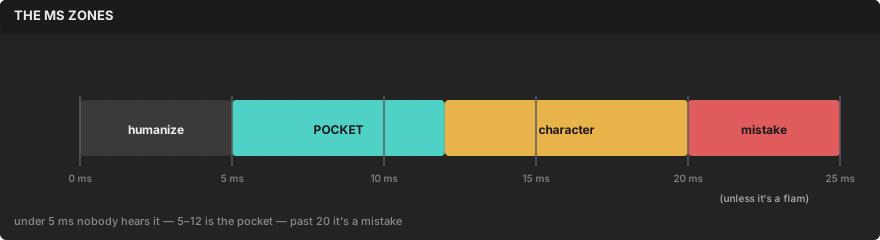
Diagram: built for this lesson
Clap +6 ms · hats +8 ms · bass +3 ms behind kick · kick never moves
That's the working tech-house pocket.
A wandering kick destroys the anchor everything else is negotiating with.
The nod test: loop 4–8 bars, close your eyes. Head nodding without effort = pocket. Thinking about the timing = not yet.
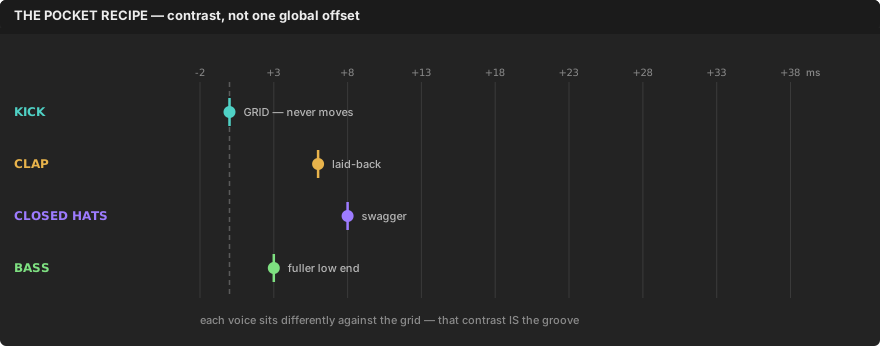
Diagram: built for this lesson
Borrow a feel at 50–80%
Find a loop you love. Right-click → Extract Groove.
Apply it to your programmed parts at 50–80% strength.
Lower percentages keep your programming's character and borrow just the feel.
Move the whole part
The track delay control (+/− ms) shifts an entire voice at once.
Delay the whole hat track +6 ms instead of moving 64 notes by hand.
Fast, global, committable.
Render −8 ms / dead on / +8 ms
Take one groove. Render three versions with the non-kick parts at −8 ms, dead on, and +8 ms.
Listen back to back. The early one feels urgent. The late one feels heavy and spacious.
That's pocket as a choice, not an accident.
It's also the fastest way to train your ear for placement.
100% on everything = drum machine
Quantize the kick (snap it to the grid). Leave everything else alone, or quantize it lightly.
Swing and pocket live in the un-quantized margins.
All +8 ms = a late track, not a pocket
Pocket is contrast: kick on the grid, hats late, clap on, bass a hair behind.
Different voices, different placements.
Two different things
Swing delays the offbeats on a fixed system. Pocket is where each voice sits against the beat.
Cranking swing to 65% doesn't create pocket. It just makes every offbeat uniformly late. You need both.
Humanize scatter = slop
Scattering timing ±10 ms at random doesn't make a pocket. It makes inconsistency.
Pocket is the same intentional placement, repeated.
Test: loop 8 bars. Feels good every time = pocket. Itches = sloppy.
Never, in 4/4
A wandering kick kills the anchor.
And don't chase numbers over feel. The ms ranges are starting points. The nod test is the verdict.