Note division & swing
How note lengths work, and how swing pushes the offbeats later.
One beat in ms = 60,000 ÷ BPM
A beat is one foot-tap. A bar is 4 beats — the time signature house lives in.
Bigger notes multiply. Smaller notes halve.
At 124 BPM (tech-house territory), one quarter note — one beat — lasts 484 ms:
| NOTE VALUE | BEATS | DURATION @ 124 BPM |
|---|---|---|
| Whole | 4 | 1935 ms (one full bar) |
| Half | 2 | 968 ms |
| Quarter | 1 | 484 ms |
| Eighth | ½ | 242 ms |
| Sixteenth | ¼ | 121 ms |
| 32nd | ⅛ | 60 ms |
Plain takeaway: learn 60,000 ÷ your BPM. That number sets every delay, every nudge, every groove.
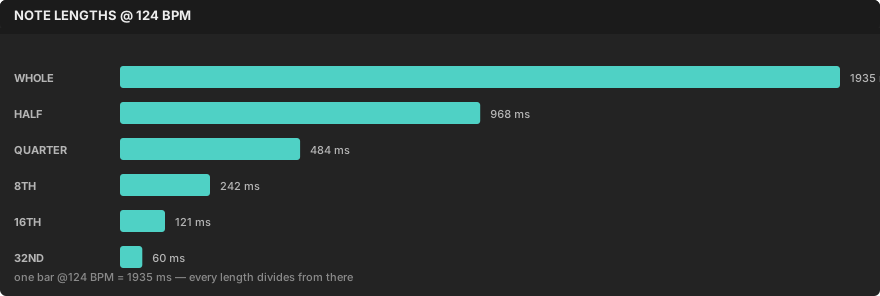
Diagram: built for this lesson
"3 in the time of 2"
Three notes squeezed into the space of two.
Each one lasts 2/3 of its normal length.
At 124 BPM, a 16th-note triplet = ~81 ms per note.
Feel map: quarter notes = drive. Offbeat 8ths = lift. 16ths = the energy dial. 32nds = fills only.
A dot = ×1.5
A dot adds half the note's value again.
A dotted 8th = an 8th + half an 8th. At 124 BPM that's ~363 ms.
The dotted-eighth delay is the classic rhythmic echo. Repeats land between the grid lines without cluttering them.
Learn your dotted-8th time at your working BPM.
Set a delay to dotted-8th at your BPM
Echo (or Simple Delay). Sync on.
Set both sides to 1/8D (the D means dotted). Feedback ~25%.
Put it on a return at 100% wet. Throw one vocal phrase or one stab into it at the end of a bar.
Driving, lopsided, thirty seconds of work.
Quarter notes, four on the floor
One per beat — steps 1, 5, 9, 13 of 16. (A bar split into 16 equal slices.)
Short, punchy, leaves room for the bass.
On the grid. Loudest thing in the track. Non-negotiable.
Beats 2 and 4
Steps 5 and 13 — half a bar apart.
Often nudged a few ms late for swagger (one famous groove uses 9 ms).
Offbeat 16ths
The slices between the beats: 1.1.3, 1.2.3, 1.3.3, 1.4.3.
(Reads: bar 1, beat 1, 3rd sixteenth.)
The defining tech-house hat pattern. The sound of house.
16th hats, shakers, ghosts
Accents land on the kick hits. Quiet swung notes sit between.
Open hats layered underneath for air.
Extra-quiet hats sitting slightly behind the beat = "feel hats."
Never all at one velocity (loudness) — see Lesson 03.
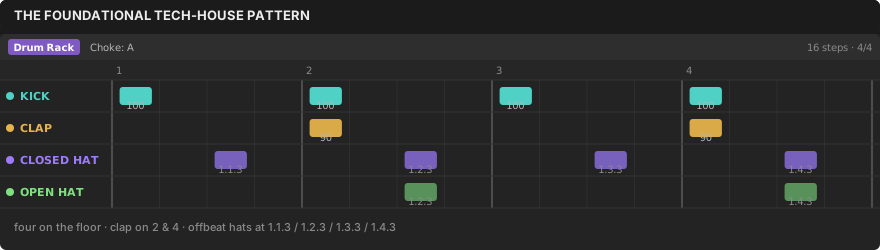
Diagram: built for this lesson
Swing delays the offbeats
Swing = pushing the offbeat notes (the ones between the beats) later, toward the next downbeat.
The downbeats don't move. That's it.
Roger Linn built it into his 1979 LM-1 drum machine (he called it "shuffle"). The MPC60's 50–75% scale made it legendary.
| SWING % | WHAT IT FEELS LIKE | OFFBEAT DELAY @ 128 BPM |
|---|---|---|
| 54% | A barely-there push (the MPC60 manual's own tip for hi-hats) | — |
| 58% | Light | ~19 ms late |
| 60% | A 3:2 ratio | — |
| 62% | The hip-hop pocket | ~28 ms late |
| 66.7% | Full triplet feel (2:1) | ~39 ms late |
| 75% | Maximum | — |
Plain takeaway: your ear hears 15–40 ms as feel, not error. That's the whole game.
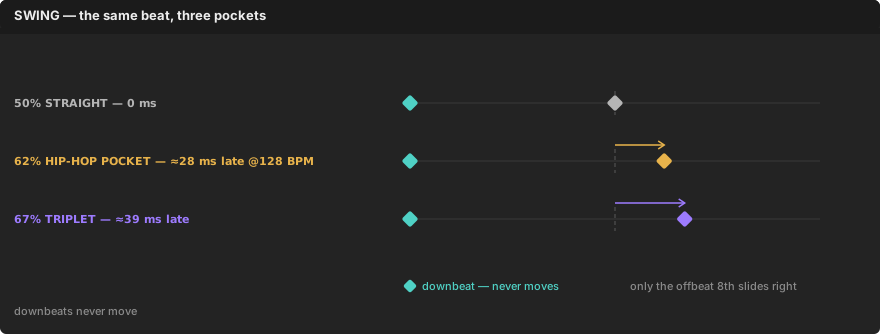
Diagram: built for this lesson
One knob
It delays the offbeat 16ths (or 8ths, in jazz) by an adjustable amount, 50–75%.
Every offbeat gets the same treatment. It's systematic.
Heavy triplet feel
Swung 8ths locked to a strong 2:1 ratio — the blues "boom-chick."
Garage shuffle lives at 62–66%.
The whole fingerprint
The superset: timing + loudness + feel, per instrument if you want.
Shorthand: swing = one delay knob. Shuffle = heavy triplet feel. Groove = everything, on every voice.
What the groove measures against
Base = the grid the groove is measured against (quarter, 8th, 16th notes…).
Quantize = snap notes to the grid, applied before the groove touches them.
Set Timing, Random, and Velocity to 0. Any groove file becomes a plain non-destructive quantize.
How much it moves, how messy
Timing = how strongly the groove moves your notes.
Random = timing wobble, a different amount per voice.
Linn's own take: "I don't think anything significant is gained by randomising playing timing."
Use Timing for feel, Random for a human touch.
−100 to +100
Velocity = how hard each hit lands — its loudness.
The groove's loudness pattern reshapes your clip's velocities.
Negative values flip the accents upside down. Flip Velocity negative on a percussion layer for instant syncopation that still belongs to the same feel.
Up to 130%
One knob that scales Timing + Random + Velocity across every groove (it lives in the Control Bar).
Automate 100→130% from breakdown to drop. The pocket widens as the track explodes.
Bake it in
The groove becomes real note positions — MIDI notes move, audio gets warp markers — and the groove slot resets to None.
Keep grooves live while arranging. Commit at mixdown.
Steal the feel
Right-click any clip (or drag it into the pool). Ableton builds a groove from its timing and loudness.
Works best on loops with clean attacks and intentional feel.
Build a personal groove library from tracks you love.
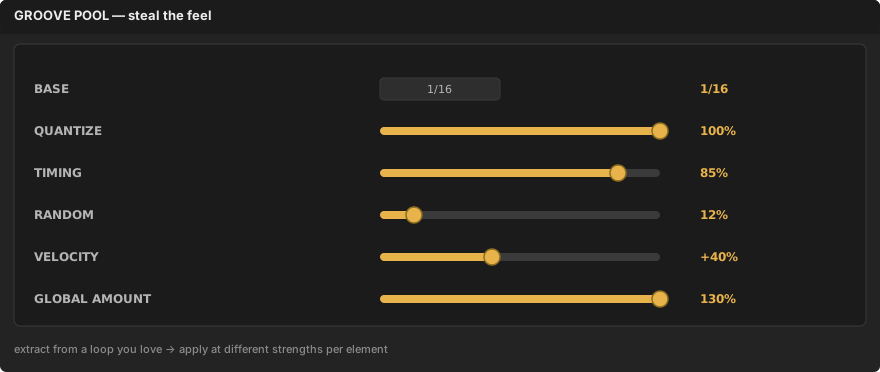
Diagram: built for this lesson
Groove each drum on its own
Pull a Drum Rack chain (say, the snare) onto its own track. Groove it separately.
A laid-back snare against grid-locked hats.
That's how you get Dilla-style per-element independence (Lesson 02) without leaving the grid.
Swung hats 54–58%, kick dead straight
16th hats on the offbeats. MPC 16 Swing groove around 54–58%. Timing ~80–100%.
The kick never moves.
The contrast between the rigid low end and the loose top end IS the tech-house groove.
Push it to 62–66%
Same hats, more delay.
An audible long-short lope with its own identity. Triplet hats are the house shuffle variant.
One shared DNA
Extract a groove from a loop you love. Apply the same file to hats (Timing 90%), bass (60%), stabs (70%).
One feel, layered — different strengths per part so it doesn't sound stamped on.
Move one part, not everything
Clap or snare a few ms late against a grid-locked kick.
And velocity (loudness) first: shape the hat velocities — accents on the downbeats, quiet ghosts between — before touching timing. It does more for feel than any nudge.
Same length, different subdivisions
Two rhythms in the same space — triplet hats over a straight kick.
They meet again on every downbeat.
The classic is 3-against-2: the groove lopes under a steady kick.
It runs from West African bell patterns through Afro-Cuban clave and jazz swing into house.
Same pulse, different lengths
Same tempo, but the loops are different sizes — a 3-beat percussion clip looping against a 4-beat kick clip.
The bar lines drift apart. They meet again after the smallest shared multiple: 12 beats (3 kick bars).
Memory trick: poly-rhythm = different rhythms, same length; poly-meter = different meters, same pulse.
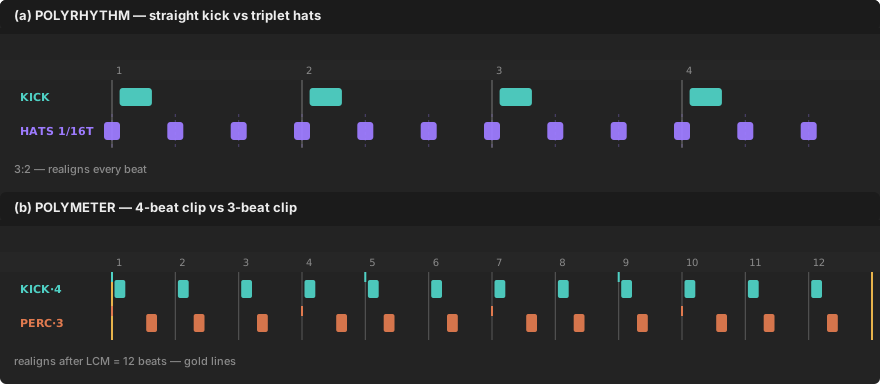
Diagram: built for this lesson
Get polyrhythmic in a minute
1. Triplet hats over a straight kick. Kick on the beats. Piano-roll grid to 1/16T (Cmd/Ctrl+3 — the T means triplet). Hats on the triplet grid. 3-against-2, meeting every beat.
2. Session View polymeter. Kick clip = 1 bar of 4/4. Percussion clip = loop brace shortened to 3 beats. Same BPM, drifting bar lines, a groove that never quite repeats.
3. Follow Actions. Stack different-length clip variations in one slot. Set Follow Action to "Next" — the clips cycle live, polymeter included.