Non-western scales & why they sound different
Different rulers, notes between the keys, and music built on melody and ornament instead of chords. What to steal, what to leave.
1 · DIFFERENT GRIDS
Your ear grew up on 12 equal steps per octave. One step per piano key. Slendro uses 5 roughly equal steps. Indian music splits the octave into 22. The ruler is unfamiliar before a single note plays.
2 · MICROTONES
A microtone is a pitch between the piano keys. A cent is a hundredth of a key step. The neutral 2nd (~150 cents) and neutral 3rd (~350 cents) sit between the keys you know. Your ear tries to round them and fails. That tension is the yearning you hear in maqam music.
3 · TUNING COMPROMISE
The 12-key system is a math compromise. It lets you change keys freely. But every interval is slightly out of tune next to pure whole-number ratios like the 3:2 fifth. Many traditions tune closer to those pure ratios, so their chords ring cleaner.
4 · BEHAVIOR, NOT NOTE SETS
A maqam or raga is not a scale. It is a pathway: where the melody starts, which notes it leans on, how it is ornamented, what mood it carries. Two maqamat can share nearly the same notes and feel nothing alike.
5 · DRONE, NOT CHORDS
Western music runs on chord progressions: tension, then resolution. A lot of non-western music is one melody over a held note: a drone. No V–I telling your ear where home is. It feels suspended and hypnotic.
6 · YOUR TRAINING DATA
The "exotic" reaction is half acoustics, half conditioning. Debussy heard Balinese gamelan at the 1889 Paris exposition and it rewired his harmony. Listen more and the strangeness fades. The techniques stay.
Maqamat are built from jins. A jins is a small cell of 3 to 5 notes. Not octave scales.
A maqam is a lower jins plus an upper jins. The lower jins is the root and names the family. The upper jins is the variant.
A tone is two keys (a whole step). Half a tone is one key.
| JINS | STEPS (TONES) | EXAMPLE | NOTE |
|---|---|---|---|
| Hijaz | ½ – 1½ – ½ | D–Eb–F#–G | The famous 3-key leap between the flat 2nd and the major 3rd |
| Rast | 1 – ¾ – ¾ | C–D–E(half-flat)–F | E-half-flat = E dropped a quarter tone, between E and Eb |
| Bayati | ¾ – ¾ – 1 | D–E(half-flat)–F–G | Opens on the neutral 2nd |
| Sikah | ¾ – 1 | E(half-flat)–F–G | The home note itself is a microtone |
| Nahawand | 1 – ½ – 1 | C–D–Eb–F | The familiar one — natural minor's first four notes |
| Kurd | ½ – 1 – 1 | D–Eb–F–G | The Phrygian cell |
Takeaway: learn the small cells first, not whole scales. Hijaz's 3-key leap is the famous one — it is the same leap as Phrygian dominant.
Start with Hijaz. Its steps: ½ – 1½ – ½. Example: D–Eb–F#–G.
The famous part is the 3-key leap between the flat 2nd and the major 3rd.
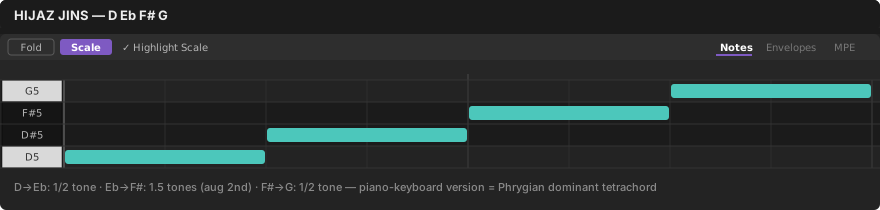
Diagram: built for this lesson
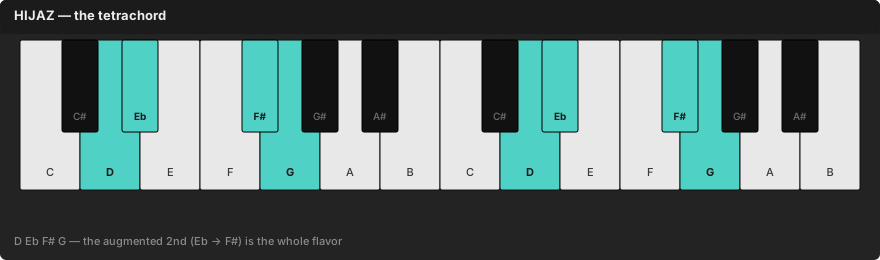
Diagram: built for this lesson
The full Hijaz maqam on piano keys is Phrygian dominant. The same scale from the last lesson.
The piano version keeps the big leap. It loses the fine shading: in real playing the Eb sits slightly high and the F# slightly low.
It also loses the behavior layer. Sayr is the path: where the melody starts, which note it leans on, how it climbs home.
Ghammaz is the pivot note. The melody keeps returning to it.
And ornamentation: the notes are targets, not fixed points.
Rast has a neutral 2nd and a neutral 3rd. Steps: 1 – ¾ – ¾. Example: C–D–E(half-flat)–F.
E-half-flat means E dropped a quarter tone. It sits between E and Eb.
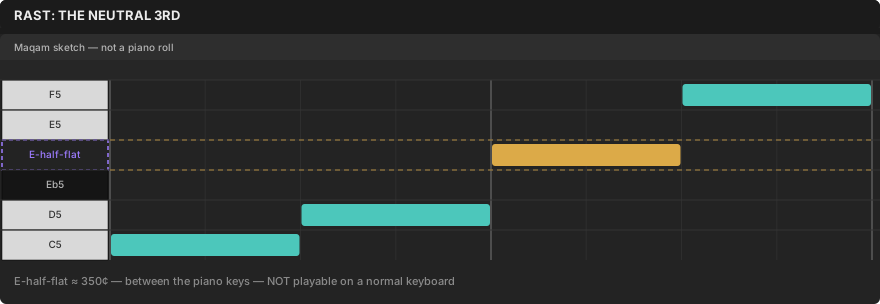
Diagram: built for this lesson
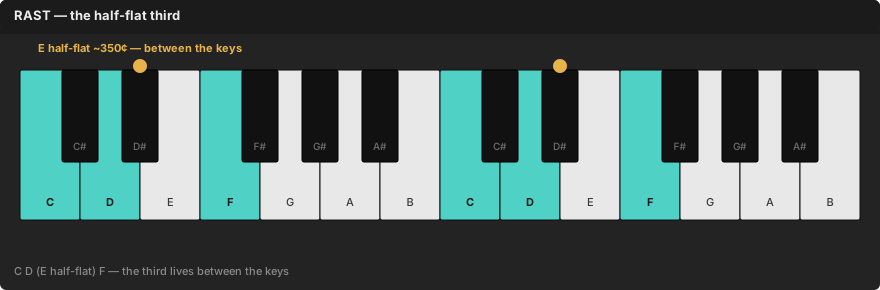
Diagram: built for this lesson
A raga is the maqam idea taken further. It is a melodic framework: rules for going up and coming down, signature phrases, and its own mood.
Ornamentation is called gamaka: bending and shaking between notes.
The vadi and samvadi are the king and queen notes. The tones the melody keeps coming back to, usually five keys apart.
The 22 shrutis are micro-divisions of the octave. Singers slide between them. That slide is called meend. It is the "vocal cry" sound.
Underneath it all: a tanpura drone. No chords. No progressions. Tension built from melody alone.
Indonesian gamelan uses two rulers that are not yours at all.
Slendro: 5 roughly equal steps. No half-steps anywhere. That is why it sounds bright, open, floating.
Pelog: 7 uneven steps. Some tiny (~100–150 cents), some huge (~250–450 cents). Tense. Melancholic. Darker.
Only 5 of the 7 play in a given piece. They are picked by the pathet: a mode, like the vadi and samvadi.
Neither maps to your piano roll. It is not wrong notes. It is a different ruler.
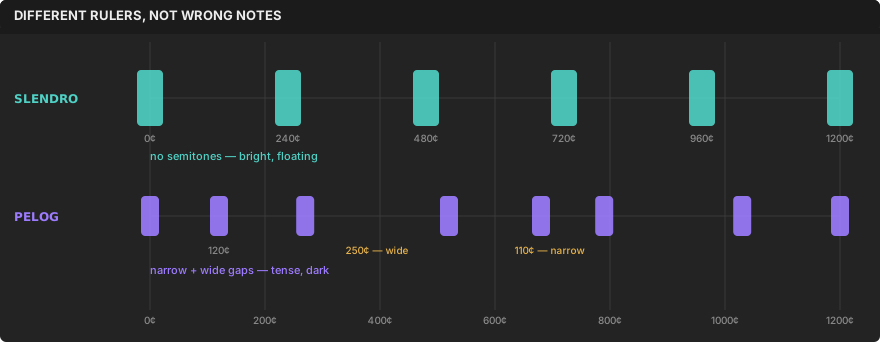
Diagram: built for this lesson
The pentatonic is five notes. It is everywhere on earth.
Five notes with no half-steps cannot clash. But the flavor changes a lot. Japanese scales show it cleanest.
| SCALE | SEMITONES | FLAVOR |
|---|---|---|
| Yo (bright) | 2–3–2–2–3 | No 4th or 7th — no leading tones, suspended, timeless |
| In / Miyako-bushi (dark) | has half-steps | The half-step crunch reads as "haunting" |
| Hirajoshi | 2–1–4–1–4 | Aeolian subset; the minor 6th is the dark Japanese color |
| Iwato | 1–4–1–4–2 | Locrian subset — b2 and b5, the most dissonant of the set |
| Kumoi | 2–1–4–2–3 | Dorian subset |
| Ritusen | 2–3–2–3–2 | Ionian subset, open and clean |
Takeaway: pentatonics with half-steps (In, Hirajoshi, Iwato) sound dark and exotic. Pentatonics without them sound bright and safe. The half-step is the spice.
Yo: bright, no half-steps. No leading tones. Suspended, timeless.
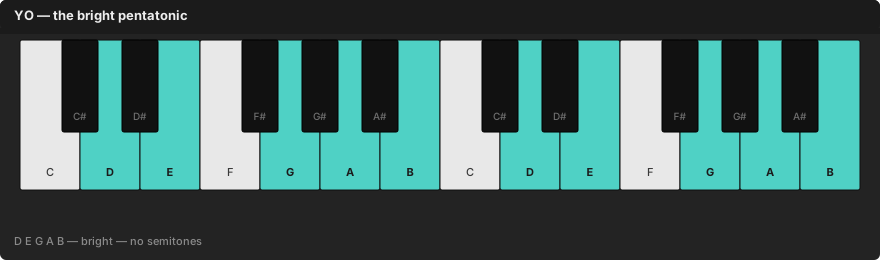
Diagram: built for this lesson
In / Miyako-bushi: dark. The half-step crunch reads as "haunting".
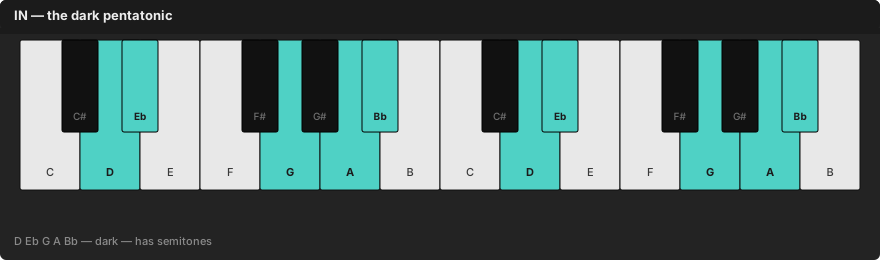
Diagram: built for this lesson
Hirajoshi: the minor 6th is the dark Japanese color.
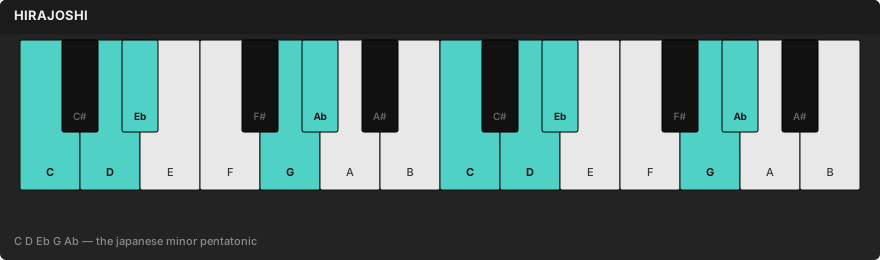
Diagram: built for this lesson
Iwato: b2 and b5 together. The most dissonant of the set.
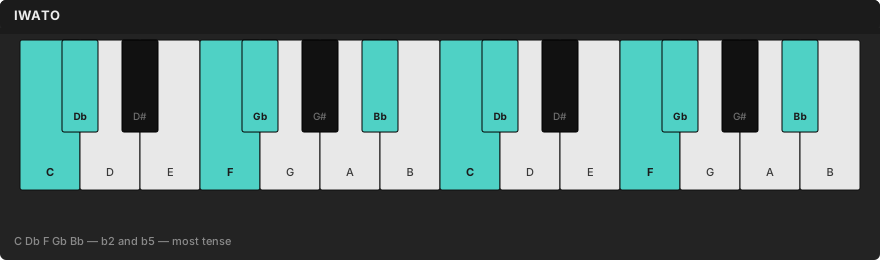
Diagram: built for this lesson
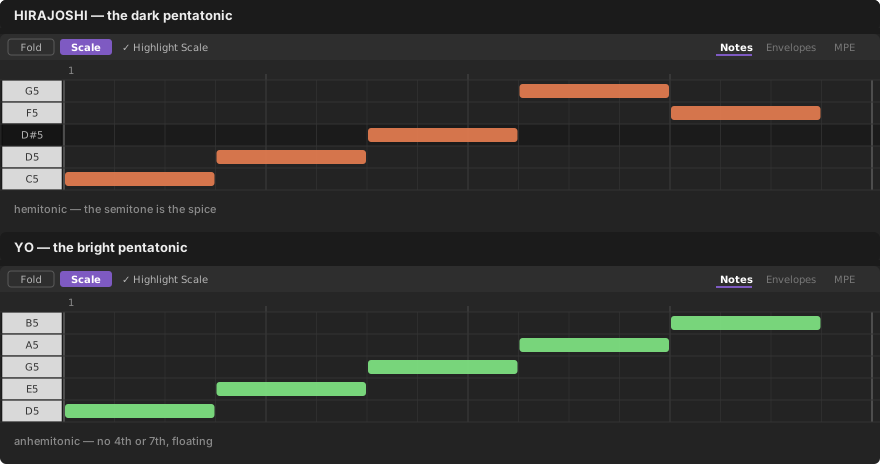
Diagram: built for this lesson
Useful for breaks: drop a Hirajoshi motif into an Aeolian track. The section goes somewhere foreign without leaving the key's neighborhood.
You do not need a tuning degree. For the indie tech flavor, do this:
Phrygian dominant notes + pitch-bend ornamentation on the lead + bass on straight roots and fifths.
Never microtune the bass. That is 80% of the sound, with zero tuning complexity.
The ornamentation is the half nobody does. Automate pitch bend on your lead or vocal chops.
Slide up into the 3rd. Dip down into the root. Grace-note into phrases.
Add ±30–50 cents of wobble on held notes.
That sells "oud player" better than the right scale alone. Real maqam identity is half ornamentation.
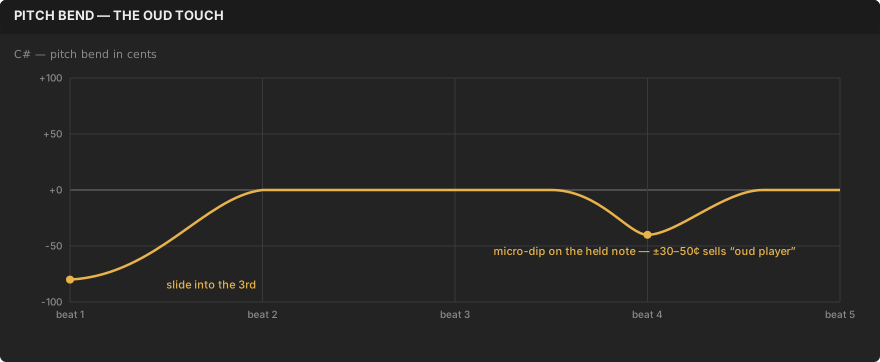
Diagram: built for this lesson
WHEN YOU NEED REAL MICROTONES
Live 12 can load alternative tuning files (Tuning Systems). Thousands of free Scala files, including maqam and raga tunings. The free Microtuner device retunes individual notes by cents, up to 128 pitches. MPE instruments (Wavetable, Sampler) let each note bend on its own.
THE HONEST CAVEAT
Club speakers do not resolve cents. Microtuned and normal-tuned parts in one track will clash unless you commit. Tune the lead and keep drums and bass straight, or tune everything. The melody translates. The tuning nuance mostly dies on a PA.
THE RHYTHM SIDE
Scales are half the non-western equation. The other half is rhythm. Interlocking percussion and off-grid feels live in the Groove Lab, the rhythm side of this lesson.